IT Jobs in Europe: Roles, Locations and Opportunities


The European technology market covers a wide range of specialist roles, and through our recruitment work across Europe, we see how demand differs between technical disciplines and locations. The right role for you will depend on your technical background, level of experience and where your skills are in demand.
If you are already based in Europe, your search may be relatively straightforward. If you are applying from another country outside Europe, you will also need to consider factors such as work authorisation, relocation and language requirements.
Our work with technology employers and professionals across Europe gives us a practical view of where specialist skills are in demand and what candidates should consider when searching for their next role. In this guide, we look at IT jobs in Europe, the roles employers are hiring for and the key factors to consider when searching for opportunities.
The IT Jobs Market in Europe
Technology employers across Europe recruit for a wide range of specialist positions. Some markets have strong demand for software engineers, while others have particular opportunities in areas such as embedded systems, automotive technology, semiconductors or telecommunications.
The European technology market also includes businesses at every growth stage, from start-ups to established technology companies, to organisations with large engineering teams. This means candidates can encounter very different working environments and technical projects when searching across the market.
For experienced professionals, it is often more useful to search according to your technical specialism than to use a broad term such as “IT jobs”.
It is possible that your particular body of prior experience may only be relevant to a relatively small part of the market. This can mean that you have fewer opportunities to choose from, but on the other hand, it can also mean there are fewer suitable candidates competing for the same specialist roles.
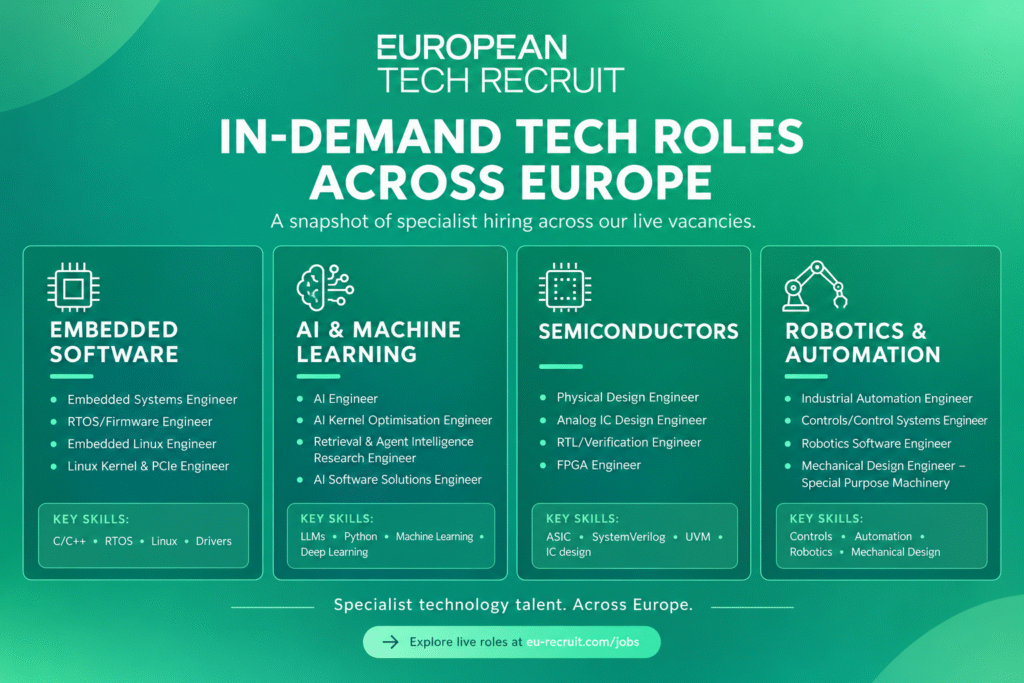
Which IT Roles Are in Demand in Europe?
There is no single technology role that dominates every European market. European recruitment covers a broad range of technology disciplines, with demand across both established and highly specialised areas.
At European Tech Recruit, we recruit across a broad range of specialist technology markets. The areas below represent some of the roles and technical disciplines we regularly work with across Europe.
Technology roles commonly recruited across European markets include:
Software engineering
Software engineering is one of our core technology recruitment specialisms, covering roles across application development, software architecture, cloud engineering and full-stack development.
We recruit software professionals across front-end, back-end, mobile and core software engineering, with searches covering technologies including Java, Python, C++, JavaScript, Swift and Kotlin. Our work also includes software architects and engineers working with cloud-native environments, microservices, Kubernetes and serverless architectures.
For candidates searching for software jobs in Europe, narrowing a search by technical specialism, programming language or development environment can help identify opportunities that match their experience more closely.
Learn more about our software engineering recruitment support.
Embedded software and systems
Embedded systems sit across several of the technology markets we recruit for, including automotive, wireless, IoT, cloud computing, high-performance computing and industrial technology.
Our embedded recruitment work covers roles including embedded software developers, firmware engineers and kernel developers, with experience spanning Linux, Android, kernel development and real-time operating systems. We have supported embedded systems recruitment across Europe since 2009, working with both established technology companies and emerging businesses.
For candidates, this means embedded opportunities can range from low-level software development to highly specialised engineering work within automotive, industrial or connected technology environments.
Find out more about our embedded systems recruitment work.
Semiconductor engineering
Semiconductor recruitment covers a wide range of highly specialised engineering roles, from chip design and verification through to physical design, validation and architecture.
We recruit semiconductor professionals including digital design engineers, analogue design engineers, verification engineers, physical design engineers, ASIC engineers, silicon validation engineers and SoC design engineers. We have worked in semiconductor recruitment for over 15 years, supporting businesses across Europe’s semiconductor market.
The wider European market is also placing strategic importance on semiconductor capability. The European Commission’s Digital Decade programme has set a target of increasing the EU’s share of global semiconductor production to 20% by 2030, making semiconductor engineering an important specialist area within Europe’s technology ecosystem.
Read more about our semiconductor recruitment services.
AI and machine learning
AI and machine learning recruitment covers a growing range of technical roles, including machine learning engineers, AI engineers, data scientists and professionals working on the development and deployment of AI technologies.
Our recruitment work spans businesses developing AI products as well as companies applying machine learning within wider technology and engineering environments. This can include roles working alongside software engineering, data science, embedded technology and advanced computing.
The wider European AI talent market is also developing rapidly. The European Commission reports that ‘AI talent has more than doubled in the EU between 2016 and 2023’, while competition for skilled professionals remains strong.
Discover our AI and machine learning recruitment expertise.
Cloud and infrastructure
Cloud and infrastructure recruitment covers the technical environments that support modern software, applications and digital services.
We have helped companies hire cloud talent including cloud engineers, cloud architects, cloud platform engineers and DevOps professionals, with recruitment across areas such as Kubernetes, Docker, Infrastructure as Code, automation, distributed systems and cloud platforms. We also recruit for roles spanning hybrid and on-premise environments.
Cloud adoption continues to grow across Europe. Eurostat reports that 52.7% of EU enterprises used paid cloud computing services in 2025, up from 45.3% in 2023. The European Commission has set a target for 75% of European businesses to use cloud-edge technologies by 2030.
Find out more about our cloud recruitment services.
Cybersecurity
Cybersecurity recruitment covers a broad range of specialist technical roles concerned with protecting systems, infrastructure, applications and data.
The skills required can span security engineering, infrastructure security, cloud security and other specialist areas. This makes cybersecurity a broad recruitment market rather than a single job category.
Cybersecurity skills remain in short supply across Europe. In its 2024 Foresight Cybersecurity Threats for 2030 update, the European Union Agency for Cybersecurity (ENISA) ranked skill shortage as the second most significant cybersecurity threat identified by its expert panel. More recent ENISA research found that difficulty finding candidates with the required skills was the main barrier to cybersecurity hiring for 45% of organisations surveyed, while the estimated shortage of cybersecurity professionals in the EU reached 299,000 in 2024.
See how we support cybersecurity recruitment.
Robotics and automation
Robotics and automation bring together several technical disciplines, including software, electrical and mechanical engineering, control systems, computer vision and artificial intelligence.
Our Industry 4.0 recruitment work covers areas including robotics, automation, IoT, AI and digital transformation. Roles can include robotics engineers, automation engineers, integration engineers, safety automation engineers, computer vision engineers, mechatronics engineers and systems engineers.
For candidates, robotics opportunities can therefore span several different engineering disciplines.
Learn more about our Industry 4.0 and robotics recruitment support.
Automotive technology
Automotive technology recruitment increasingly overlaps with software engineering, embedded systems, AI and advanced sensing technologies.
Our automotive recruitment work includes roles such as embedded software engineers, low-level developers, machine learning developers, software test engineers and C++ engineers. We have also supported recruitment for autonomous driving projects involving embedded systems, Linux engineering and software architecture.
For technology professionals, automotive opportunities can therefore extend well beyond traditional automotive engineering into software, autonomous systems and other specialist technology disciplines.
Explore our automotive technology recruitment expertise.
Data and analytics
Data recruitment covers roles responsible for collecting, managing, analysing and applying data within technology and business environments.
We recruit across a range of data roles, from data analysts and data engineers to senior data leadership positions, supporting businesses across Europe and the UK.
Data analytics is also becoming more widely embedded in European businesses. The European Commission tracks data analytics as one of its Digital Decade indicators, covering the use of technologies and software to analyse data, identify patterns and support decision-making.
Find out more about our data science recruitment services.
Telecommunications and wireless technology
Telecommunications and wireless recruitment covers specialist engineering roles across connectivity, radio frequency, networking and wireless communications.
Our recruitment work includes RF engineers, wireless engineers, RAN engineers, DSP engineers, antenna engineers, wireless software engineers and standardisation delegates. We also recruit across technologies including 5G, Bluetooth, IoT and cellular networks.
This area increasingly overlaps with other specialist technology markets. For example, wireless recruitment can involve embedded software, semiconductor technology, cybersecurity and networking, depending on the role and product being developed.
Read more about our telecommunications recruitment expertise.

Where Are the Main Tech Jobs in Europe?
Different European markets offer different opportunities for technology professionals, depending on their technical specialism, industry experience and career goals. Rather than looking only at the largest technology hubs, it can be useful to consider what each market is particularly strong in.
Germany
Germany is particularly relevant for technology professionals working across software, engineering and industrial technology. The country has a strong automotive industry alongside established capabilities in semiconductors, electronics, software and industrial automation.
Germany’s automotive sector is undergoing significant technological change, with investment and development across areas including software-defined vehicles, autonomous driving, electrification and automotive electronics.
The country also has a significant semiconductor industry, with demand driven by automotive electronics, power semiconductors, sensors and industrial automation. Germany’s semiconductor ecosystem also includes chip design activity across automotive, industrial, AI, data-centre and mixed-signal applications.
For candidates with experience in embedded software, automotive technology, semiconductor engineering, industrial automation or software development, Germany can therefore offer opportunities across both established engineering businesses and specialist technology companies.
Netherlands
The Netherlands is particularly strong in high-tech systems and advanced engineering. Its technology ecosystem includes semiconductor technology, photonics, robotics, quantum technology and other specialist areas where software and hardware development often overlap.
The country’s high-tech systems and materials sector includes a substantial semiconductor ecosystem, as well as activity across robotics, photonics and advanced manufacturing. This makes the Netherlands particularly relevant for professionals working in semiconductor engineering, embedded systems, robotics, photonics and other advanced technology fields.
Research-led technology clusters also bring companies, universities and research organisations into close proximity, which can be particularly relevant for candidates interested in R&D-focused roles.
The Netherlands also has an established international business environment. For candidates working in specialist engineering and emerging technology fields, this combination of technical expertise and international business activity can make the Netherlands a market worth considering.
Ireland
Ireland can be particularly relevant for technology professionals looking to work in international technology and R&D environments. The country’s technology sector has developed around areas including software, cloud computing, cybersecurity, data analytics and artificial intelligence, alongside a well-established semiconductor and microelectronics industry. The Irish Government identifies these areas among the technologies contributing to the continued growth of Ireland’s technology sector.
Ireland is also a significant European semiconductor location. The Irish Government’s National Semiconductor Strategy reports that the sector directly employs more than 20,000 people and includes activity across advanced manufacturing, chip design and R&D.
The country’s digital technology workforce is also expected to expand. A 2026 report from Ireland’s Expert Group on Future Skills Needs estimates that around 168,800 digital specialists were employed in Ireland in 2025, with demand projected to exceed 215,000 by 2030. The strongest demand is expected in AI and machine learning, cybersecurity, data, cloud and software engineering.
For candidates with experience in software engineering, AI, cybersecurity, cloud, data or semiconductors, Ireland therefore offers a technology market with established industry depth as well as projected demand for specialist skills.
Portugal
Portugal has developed a substantial and increasingly internationalised technology ecosystem. Its ICT and electronics sector includes around 32,000 companies and more than 204,000 professionals, with activity spanning areas such as software, AI, cloud computing, cybersecurity and data analytics, according to AICEP – Portuguese Trade & Investment Agency.
The market is also attracting international technology investment. Portugal’s digital sector includes international businesses and technology teams working across software development, AI, cloud and other digital technologies.
For candidates looking for opportunities within an international technology environment, Portugal can therefore be relevant across software engineering, cloud, AI and other digital technology disciplines. Its growing technology ecosystem also makes it a market worth considering beyond its better-known technology locations.
IT Jobs for International Candidates
Searching for IT jobs for international candidates involves some additional considerations.
If you are applying from outside the EU, you may need permission to work in the country where the position is based. The relevant requirements for permission can vary between countries and can also depend on the type of role you’re applying for, and your own personal circumstances.
Some employers can support international hiring, but sponsorship is not available for every vacancy. So, before applying, check:
- Where the role is based
- Whether you already have the right to work there
- Whether relocation is required
- Whether the employer can support international candidates
- Whether there are language requirements
Your technical experience remains central to the application, but practical considerations can determine whether a particular opportunity is suitable.

How to Find IT Jobs in Europe
A focused search can make it easier to identify relevant opportunities.
Start with your technical specialism
Rather than searching for “IT jobs” alone, consider the area in which you have the strongest experience.
For example, someone working in embedded software will have a different set of relevant opportunities from a cloud engineer or cybersecurity professional.
This approach can also help you identify which European countries have employers recruiting for your particular skill set.
Check the location and work requirements
Look at the location of the role before applying, particularly if you are currently outside Europe.
Check whether the employer expects you to relocate, whether remote working is available and whether you have the necessary right to work in the country where the role is based.
If sponsorship is important to you, also look for confirmation that the employer can support international applicants rather than assuming that it will be available.
Read the full job description
Job titles are not standardised across the technology sector.
Two employers may use the same title for positions with different responsibilities. For example, a software engineer role at one company could focus on application development, while another may require experience with embedded systems or cloud infrastructure.
The job description should give you a clearer idea of the technical experience, responsibilities and level of seniority required.
Make your technical experience easy to identify
If you’re applying for a software engineering position, don’t make the recruiter search through four pages of your CV to find your Python, Java or C++ experience. Make the technologies, platforms, industries and projects relevant to the position clear from the beginning of your CV.
If the role requires experience with a particular technology or development environment, make sure that experience is easy to find. This helps the recruiter quickly understand whether your background matches the position.
Consider specialist recruitment
Specialist technology recruitment can provide another route into the European market.
We work with employers hiring for roles where specific technical experience can be difficult to find. For candidates, this means we can discuss opportunities based on their technical background rather than simply matching them to a generic IT vacancy.
Finding Your Next IT Role with European Tech Recruit
At European Tech Recruit, we work with technology professionals across areas including software engineering, semiconductors, embedded systems, AI and machine learning, robotics, automotive technology, and cloud infrastructure.
We specialise in technology recruitment and work internationally with candidates across highly technical and specialist markets. Our understanding of these roles allows us to discuss opportunities based on your technical experience, the technologies you work with and the type of position you are looking for.
We work with technology employers across Europe, giving candidates access to specialist opportunities that may not be advertised through general job platforms. Where relocation is involved, we can also discuss the practical requirements of the role and location.
Our aim is to make the process clear from the beginning, so you understand the role and its requirements before progressing with an application.
Frequently asked questions
Which IT jobs are in demand in Europe?
Demand varies between countries and industries. Software engineering, AI and machine learning, cybersecurity, cloud and infrastructure are among the areas where European employers recruit specialist technology professionals. The specific skills required will depend on the role and employer, however.
How do I apply for tech roles in Europe?
Start by identifying the technical roles and European markets that match your experience. Check the location, work authorisation and language requirements for each vacancy before applying. Tailor your CV to the position and make your relevant technical experience clear.
What should I consider when looking for IT jobs in Europe?
If you are already based in Europe, consider the countries and locations where your technical experience is most relevant. Check whether the role requires relocation, specific language skills or other location-based requirements, and make sure your CV clearly shows the technologies and experience relevant to the position.
Which European countries have IT jobs for international candidates?
Technology jobs are available across European markets including Germany, the Netherlands, Ireland and Portugal. The most relevant location will depend on your technical specialism, experience, and work authorisation.
Do I need to speak the local language to get an IT job in Europe?
Not necessarily. Some technology employers operate primarily in English, particularly in international working environments. However, language requirements vary by employer and location. Speaking the local language can also open up a wider range of positions in some markets.
Hiring Technology Professionals in Europe?
If you are an employer looking for specialist technology professionals, European Tech Recruit can support your recruitment needs across a range of technical sectors. We work with companies hiring for specialist roles, where finding candidates with the right technical experience can be challenging.